MCP Servers vs Power Platform Connectors: What's the Difference?

Howdang Rashid
Saturday, 22 August 2026 · 3 min read
Two technologies now compete to connect AI to your systems, and they come from opposite philosophies. MCP (Model Context Protocol) is the open standard - created by Anthropic - for LLM tool-calling. Power Platform connectors are Microsoft's proprietary, governed wrappers around REST APIs. Both matter, and choosing well means understanding how differently they think.
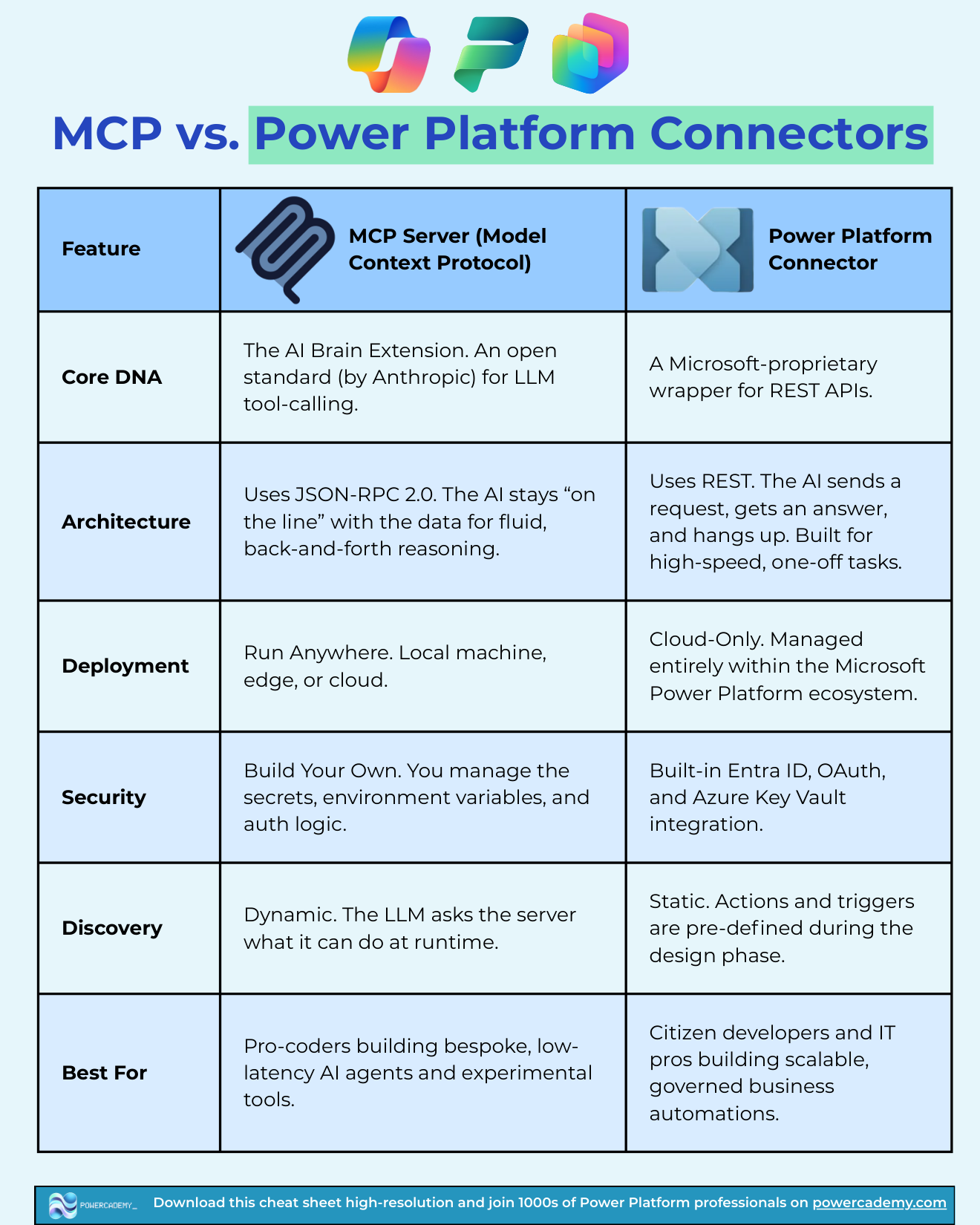
Want the hi-res version? It's free in the Powercademy Success Kit.
What's the difference at a glance?
MCP Server | Power Platform Connector | |
|---|---|---|
Core DNA | Open standard (by Anthropic) for LLM tool-calling | Microsoft-proprietary wrapper for REST APIs |
Architecture | JSON-RPC 2.0 - the AI stays on the line for fluid back-and-forth reasoning | REST - request, answer, hang up; built for high-speed one-off tasks |
Deployment | Anywhere - local, edge, or cloud | Cloud-only, managed in the Power Platform |
Security | Build your own - secrets, env vars, auth logic | Built-in Entra ID, OAuth, Key Vault |
Discovery | Dynamic - the LLM asks the server what it can do at runtime | Static - actions and triggers pre-defined at design time |
When should you use an MCP server?
MCP is the AI brain extension: because the model stays "on the line" with your data over JSON-RPC, it can reason back and forth - query, inspect the result, refine, act. Dynamic discovery means the agent learns what a server can do at runtime rather than being hard-wired at design time. It's the natural choice for pro-coders building bespoke, low-latency AI agents and experimental tools - and increasingly the standard the whole agent ecosystem (including Microsoft's) is adopting.
When should you use a Power Platform connector?
Connectors are the governed workhorses: 1,500+ prebuilt integrations with Entra ID, OAuth, and Key Vault security built in, DLP policies enforced by the platform, and a design-time model that admins can audit. For citizen developers and IT pros building scalable, governed business automations, connectors are unbeatable - the security you'd have to build yourself with MCP comes free.
Do you have to choose?
Less and less. Microsoft is bringing MCP into the Power Platform - Copilot Studio agents can consume MCP servers, and Dataverse exposes MCP - so the pragmatic pattern is connectors for governed business automation, MCP for agent reasoning, with the two meeting inside your agents. The protocols reflect their origins: MCP optimises for what AI can do, connectors for what IT can govern. You'll want both.
FAQ
Can Copilot Studio agents use MCP servers?
Yes - Copilot Studio supports MCP, letting agents consume MCP servers alongside connectors. That's exactly the hybrid pattern: governed connectors for business systems, MCP for richer agent tooling.
Is MCP secure enough for enterprise use?
It can be - but security is your responsibility: authentication, secrets management, network boundaries, and audit are yours to design. Connectors give you Microsoft's identity stack out of the box. That difference is the real enterprise trade-off.
Will MCP replace connectors?
Unlikely. Connectors solve governance and citizen-developer scale, which MCP doesn't try to. Expect convergence instead: MCP as the agent-facing protocol, connectors as the governed transport underneath many of the same integrations.
What's a good first MCP project for a Power Platform developer?
Point an MCP-capable client at Dataverse's MCP support and let an agent query your dev environment's data. You'll see dynamic discovery and stay-on-the-line reasoning working against a platform you already understand.
The hi-res version of this comparison is in the Powercademy Success Kit - free, along with hundreds of other cheat sheets, roadmaps, and guides for Microsoft professionals.