Power Platform in 2026-2028: What Development Will Mean in the AI Era

Howdang Rashid
Saturday, 22 August 2026 · 3 min read
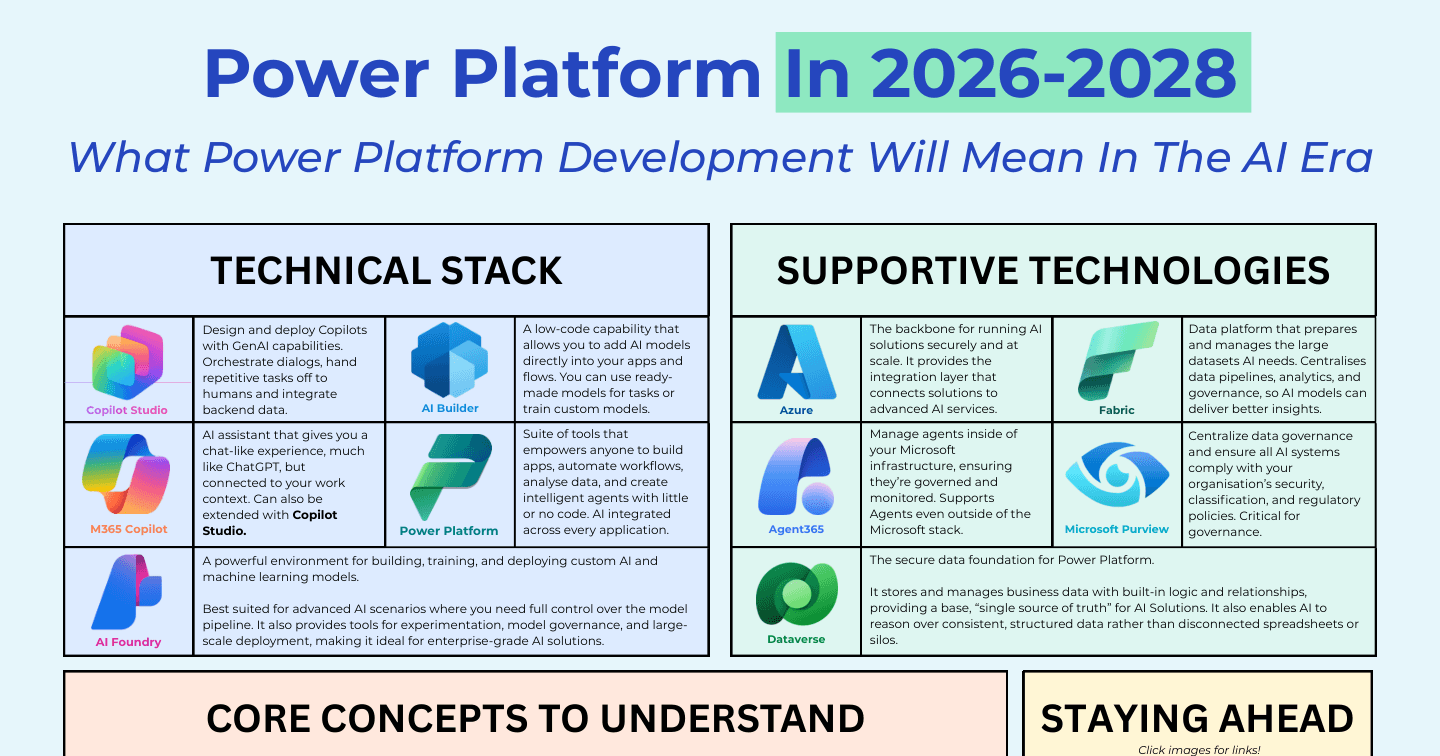
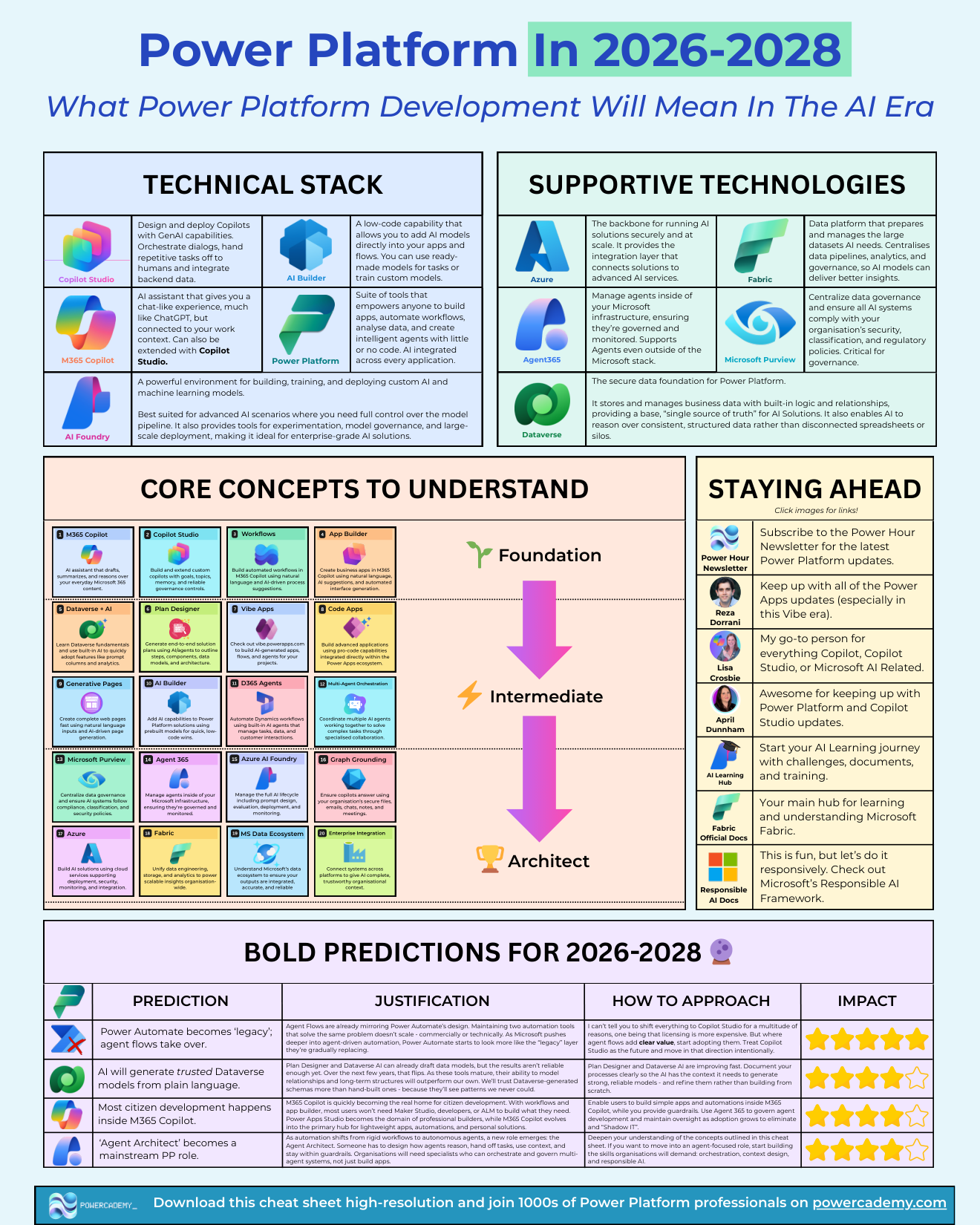
Power Platform development is being redefined around AI, and the 2026-2028 window is where that shift becomes the job description. The stack now spans Copilot Studio, AI Builder, M365 Copilot, and Azure AI Foundry on the AI side, with Dataverse, Fabric, Purview, Azure, and Agent 365 forming the data and governance backbone underneath. This cheat sheet maps what Power Platform development will mean in the AI era - the technical stack, the supporting technologies, and the concepts worth understanding now.
Want the hi-res version? It's free in the Powercademy Success Kit.
What does the AI-era technical stack look like?
Power Platform - The suite that lets anyone build apps, automate workflows, analyse data, and create intelligent agents with little or no code - now with AI integrated across every application.
Copilot Studio - Design and deploy copilots with generative AI: orchestrate dialogs, hand repetitive work between agents and humans, and integrate backend data.
AI Builder - Low-code AI models dropped directly into apps and flows: ready-made models for common tasks, or custom-trained ones for yours.
M365 Copilot - The chat-style AI assistant connected to your work context, extensible with Copilot Studio.
Azure AI Foundry - The environment for building, training, and deploying custom AI models when you need full control of the pipeline: experimentation, governance, and enterprise-scale deployment.
What supports the stack underneath?
Dataverse - The secure data foundation: a single source of truth that lets AI reason over consistent, structured data instead of disconnected spreadsheets and silos.
Microsoft Fabric - Prepares and manages the large datasets AI needs, centralising pipelines, analytics, and governance.
Azure - The backbone for running AI solutions securely at scale, connecting Power Platform solutions to advanced AI services.
Agent 365 - Manage agents inside your Microsoft infrastructure, governed and monitored - including agents built outside the Microsoft stack.
Microsoft Purview - Centralised data governance that keeps every AI system compliant with security, classification, and regulatory policy.
Graph grounding - Ensures copilots answer from your organisation's secure files, emails, chats, notes, and meetings rather than the open internet.
What does this mean for Power Platform developers?
The role is widening, not disappearing. Apps and flows remain the delivery vehicles, but the differentiating skills shift toward the layer around them: grounding agents on trusted Dataverse data, governing them through Managed Environments, Agent 365, and Purview, and knowing when a scenario outgrows low-code AI Builder and needs Foundry. The developers who thrive in 2026-2028 will be the ones who treat AI as another workload to architect - with data quality, security, and lifecycle management - rather than a feature to switch on. Staying ahead is a habit: follow the community voices, subscribe to platform update sources, and rebuild one of your own solutions with agents to feel the shift first-hand.
FAQ
Will AI replace Power Platform developers?
AI is replacing tasks, not the role. Screen-building and formula-writing are getting automated; data modelling, governance, integration, and judgement about what to build are becoming more valuable. The role shifts from builder to architect-of-outcomes.
Do I need to learn Azure AI Foundry as a low-code developer?
You need to know what it is for and when a scenario needs it, not master it. Copilot Studio and AI Builder cover most business cases; Foundry enters when you need custom model pipelines, fine-grained control, or enterprise-scale AI governance.
What is Agent 365?
Microsoft's management layer for agents: registering, governing, and monitoring them inside your infrastructure, including agents built outside the Microsoft stack. As organisations deploy dozens of agents, this control plane becomes as important as the agents themselves.
Where should I start preparing today?
Two moves: get your data story right (Dataverse modelling, plus a working understanding of Fabric), and build one real agent in Copilot Studio grounded on that data. Those two projects cover most of the concepts on this sheet in practice.
The hi-res version is in the Powercademy Success Kit - free, along with hundreds of other cheat sheets, roadmaps, and guides for Microsoft professionals.