Why Use Dataverse? The Playbook for "But SharePoint Is Free"

Howdang Rashid
Saturday, 22 August 2026 · 3 min read
If you've ever heard "let's just use SharePoint, it's free" - this playbook is for you. It gives you a crisp pitch anyone can understand, the AI and data arguments that actually work on decision-makers, a battle-tested objection-to-answer table, and (crucially) the honesty about when SharePoint genuinely is fine. Winning this conversation is about credibility, not zealotry.
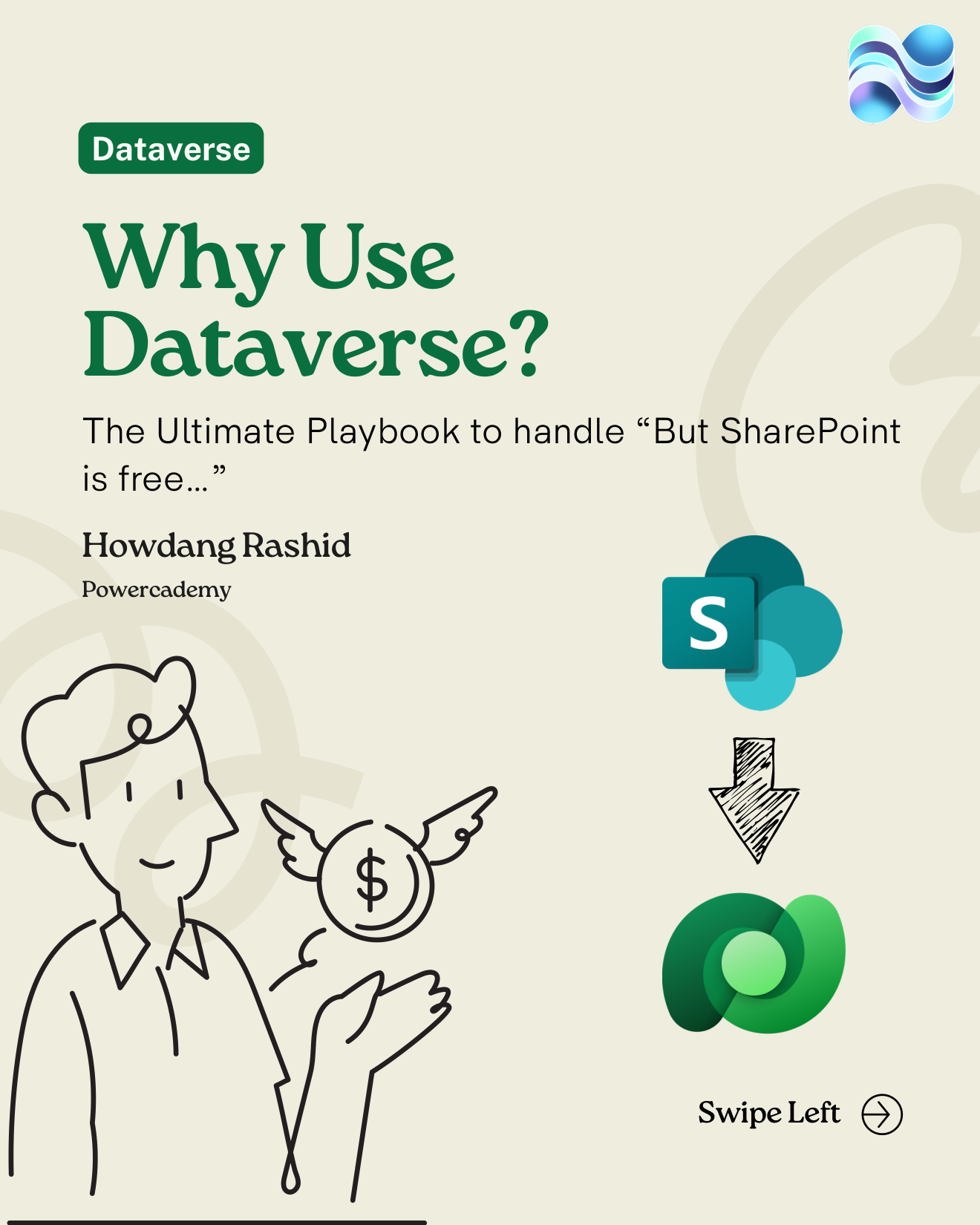
The full playbook is free in the Powercademy Success Kit.
What's the core pitch?
Dataverse is the Power Platform's native, relational data layer - designed for business apps, automation, analytics, and governance at scale. Translation for stakeholders: fewer hacks, cleaner data, happier audits, better apps. SharePoint gives you basic lookups where Dataverse gives you full relational tables; site-level permissions where Dataverse secures down to rows and columns; flow-driven logic where Dataverse has business rules, server-side logic, and rollups; and limited structure where Dataverse brings solutions, environments, and pipelines.
Why is AI-readiness the argument that wins in 2026?
AI thrives on clean schemas, relationships, and consistent metadata - and that is exactly what Dataverse enforces out of the box. Tables, columns, relationships, views, and business rules structure your data so copilots can reason over it, and Dataverse and model-driven apps ship with built-in Copilot features. When leadership asks "are we AI-ready?", data structure is the honest answer, and it's the argument SharePoint simply can't match.
What about security and governance?
The stack speaks for itself: role-based security down to table, row, and column level; managed environments, data loss prevention, and monitoring; Dev/Test/Prod environment strategy with proper ALM to avoid wild-west builds; and business units with security roles for least-privilege access by region or department. This is the difference between a solution IT tolerates and one IT sponsors.
How do you answer the common objections?
Objection | Answer |
|---|---|
"SharePoint is free." | Price isn't cost. Dataverse reduces rework, performance pain, and security gaps, and enables governed Dev/Test/Prod. |
"We only have a few thousand rows." | You'll grow. Dataverse stays reliable as users, relationships, and automation scale. |
"AI works on SharePoint too." | Sure - but structured entities and relations in Dataverse feed better prompts, actions, and analytics for copilots. |
"We'll be locked into Dataverse." | Dataverse has a Web API, virtual tables, and integration patterns for external data - it's a hub, not a cage. |
When is SharePoint genuinely fine?
Say this part out loud - it's what makes the rest credible: SharePoint is the right call for small, flat lists with low security needs, few relationships and low data volume, and short-lived or team-only solutions. And the hybrid pattern mature teams land on: documents in SharePoint, data in Dataverse. Dataverse file storage is expensive; SharePoint document libraries are excellent. Combine them and you get libraries, relational data, analytics, and a real security model.
FAQ
What's the single strongest argument for Dataverse?
In 2026: AI-readiness. Structured, related, governed data is what makes copilots and agents actually useful - and it's the argument executives already care about before you walk in.
How do I justify the licence cost concretely?
Price the alternative honestly: maker hours fighting delegation limits, flows rebuilt around missing server-side logic, security incidents from item-level permissions, and the migration project when the list outgrows itself. Licences are the cheap part of that ledger.
Is the documents-in-SharePoint pattern hard to set up?
No - Dataverse has native SharePoint integration that links document libraries to records. It's configuration, not code, and it keeps your expensive Dataverse file capacity for what actually needs it.
What if the decision has already been made for SharePoint?
Ship it gracefully, and instrument the pain: track the delegation workarounds, permission tickets, and flow-run costs. Revisit with data in six months. "I told you so" loses arguments; evidence wins them.
The full playbook is in the Powercademy Success Kit - free, along with hundreds of other cheat sheets, roadmaps, and guides for Microsoft professionals.