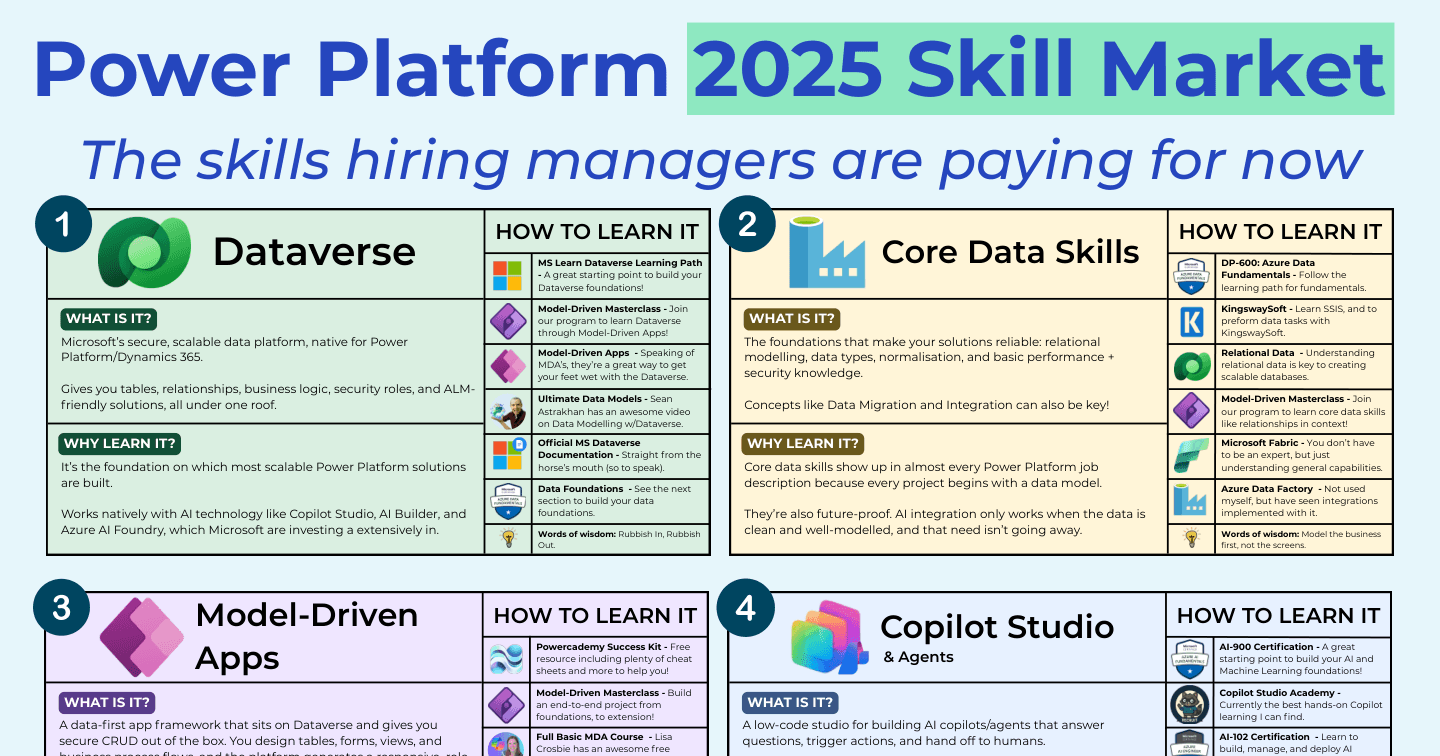
The Power Platform Skills Hiring Managers Are Paying For

Howdang Rashid
Saturday, 22 August 2026 · 3 min read
Not all Power Platform skills are paid equally. The market rewards the ones that make solutions scale: Dataverse, core data skills, model-driven apps, Copilot Studio, process automation, and ALM. This cheat sheet breaks down each of the six - what it is, why hiring managers pay for it, and exactly how to learn it.
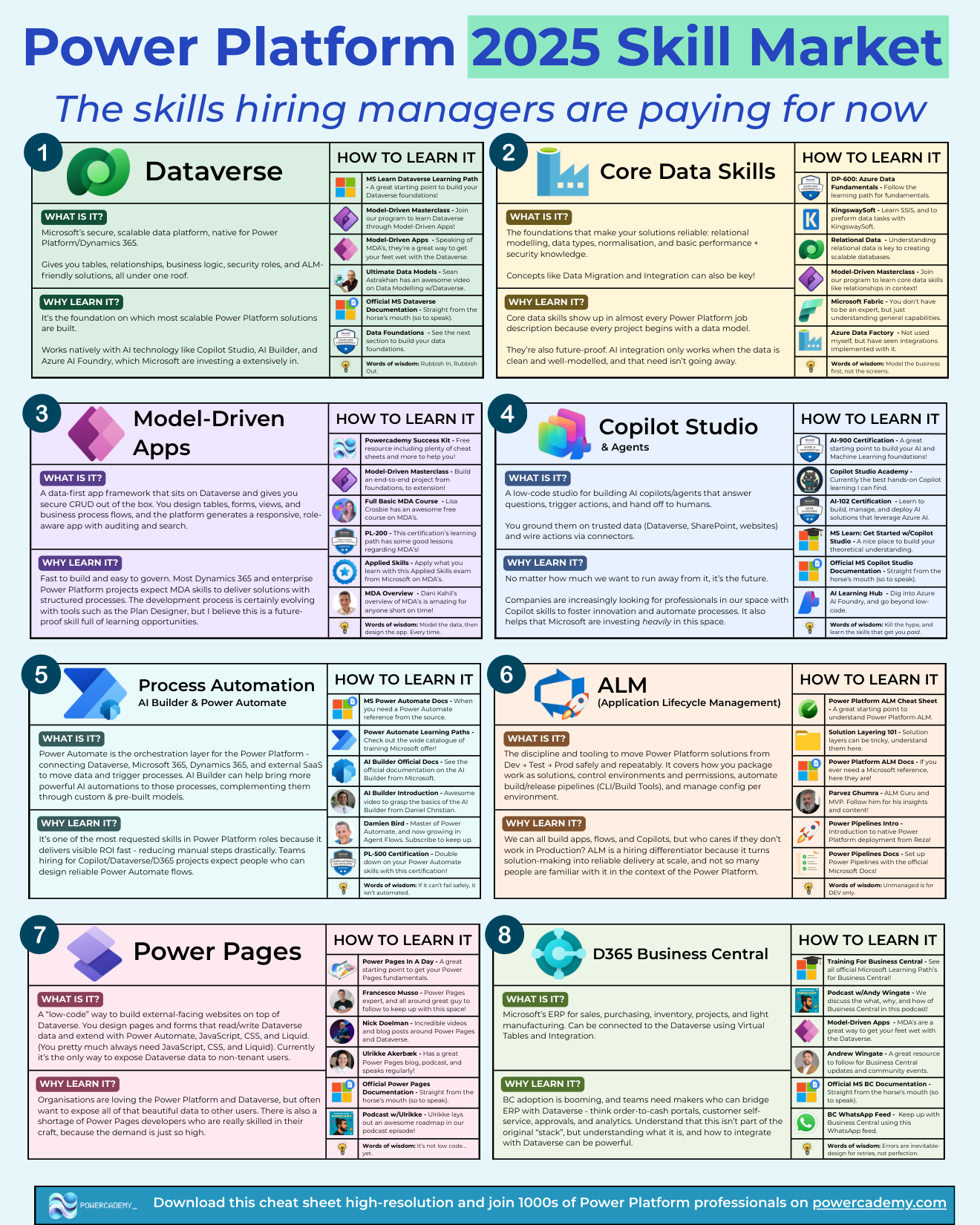
Want the hi-res version? It's free in the Powercademy Success Kit.
What are the six skills hiring managers pay for?
Dataverse - Microsoft's secure, scalable data platform: tables, relationships, business logic, security roles, and ALM-friendly solutions under one roof. The foundation most scalable Power Platform solutions are built on, and it works natively with Copilot Studio, AI Builder, and Azure AI Foundry.
Core data skills - Relational modelling, data types, normalisation, and basic performance and security knowledge, plus migration and integration. Every project begins with a data model, and AI only works when the data is clean and well-modelled.
Model-driven apps - The data-first app framework on Dataverse: secure CRUD out of the box, responsive role-aware apps with auditing and search. Most Dynamics 365 and enterprise Power Platform projects expect these skills.
Copilot Studio - Building AI copilots and agents that answer questions, trigger actions, and hand off to humans, grounded on trusted data. Companies are increasingly hiring for these skills, and Microsoft is investing heavily.
Process automation - Power Automate as the orchestration layer connecting Dataverse, M365, Dynamics 365, and external SaaS, with AI Builder adding intelligent document and text processing. One of the most requested skills because it delivers visible ROI fast.
ALM - Moving solutions from dev to test to production safely and repeatably: solutions, environment strategy, pipelines, and per-environment configuration. A genuine differentiator because far fewer people know it.
Why do data skills top the list?
Because the Power Platform is a data game. Dataverse and core data skills appear in almost every job description for a reason: every app, flow, agent, and report is only as good as the model underneath it. Rubbish in, rubbish out - and in the AI era that compounds, because agents grounded on messy data produce confidently wrong answers. Model the business first, not the screens, and every other skill on this list gets easier.
How should you learn these skills?
Pair one certification path with one hands-on build per skill. For Dataverse and model-driven apps, the MS Learn Dataverse path and PL-200 give you theory while an end-to-end project makes it stick. For Copilot Studio, start with AI-900 foundations, then build a real agent grounded on your own data. For automation, the PL-500 path plus a flow that survives failure teaches more than any video. For ALM, set up solutions and pipelines on a personal environment before you ever need them at work - it is the skill hiring managers least expect a self-taught candidate to have, which is exactly why it stands out.
FAQ
Which skill should I learn first?
Core data skills, through Dataverse. They underpin every other item on the list, and model-driven apps are the most practical way to learn them in context.
Are canvas apps not on the list any more?
Canvas skills still matter, but the market premium has shifted to data-first delivery: Dataverse, model-driven apps, and ALM. Canvas is increasingly the easy part; the paid part is making solutions scale and survive production.
Do I need Azure skills too?
A working awareness helps - Azure AI Foundry for agents beyond low-code, Azure DevOps for pipelines, and Fabric at a capabilities level. You do not need to be an Azure expert to command a strong Power Platform salary, but knowing where the platform hands off to Azure makes you more valuable.
How do I prove these skills without job experience?
Build and document projects that demonstrate them: a model-driven app with a proper data model, a flow with error handling, an agent grounded on real data, and a solution moved through environments. Certifications open doors; documented delivery closes them.
The hi-res version is in the Powercademy Success Kit - free, along with hundreds of other cheat sheets, roadmaps, and guides for Microsoft professionals.