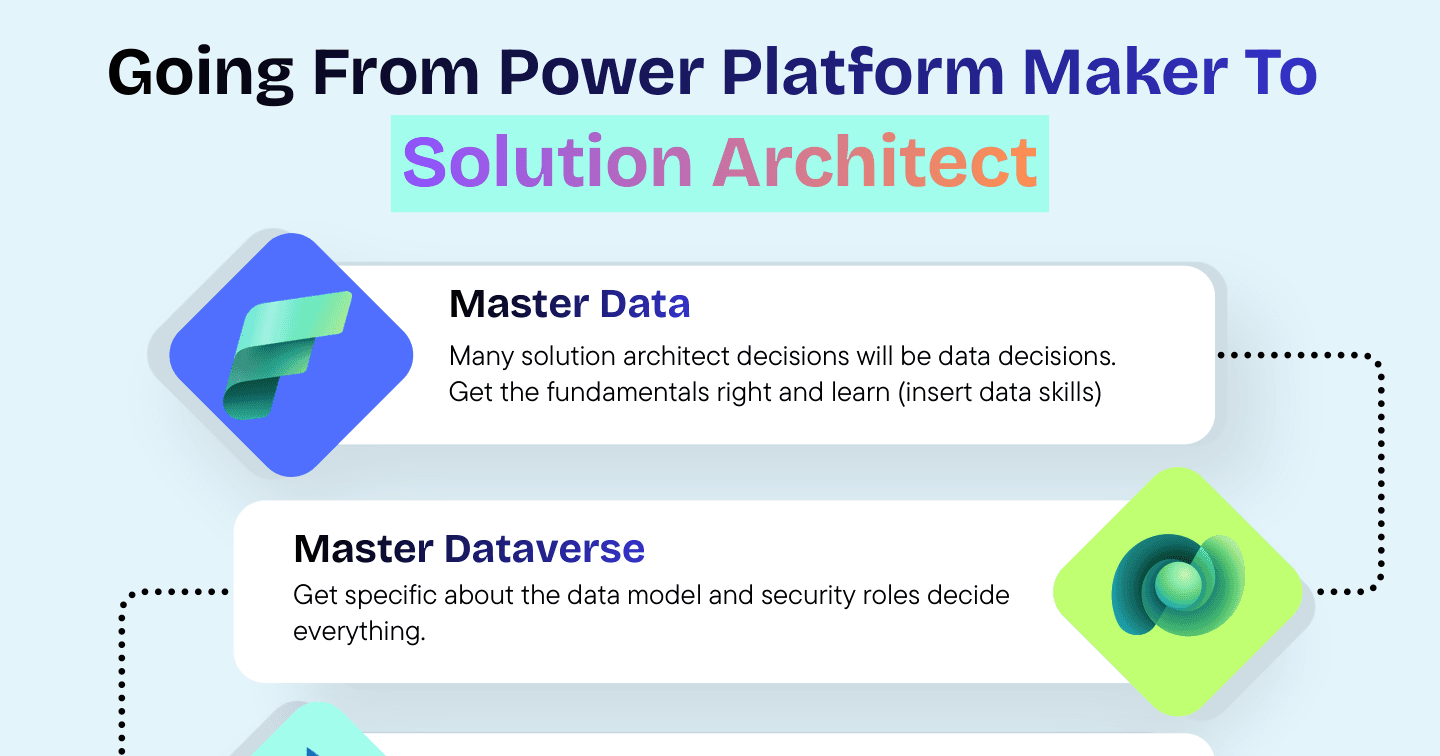
Going From Power Platform Maker to Solution Architect: The Roadmap

Howdang Rashid
Saturday, 22 August 2026 · 3 min read
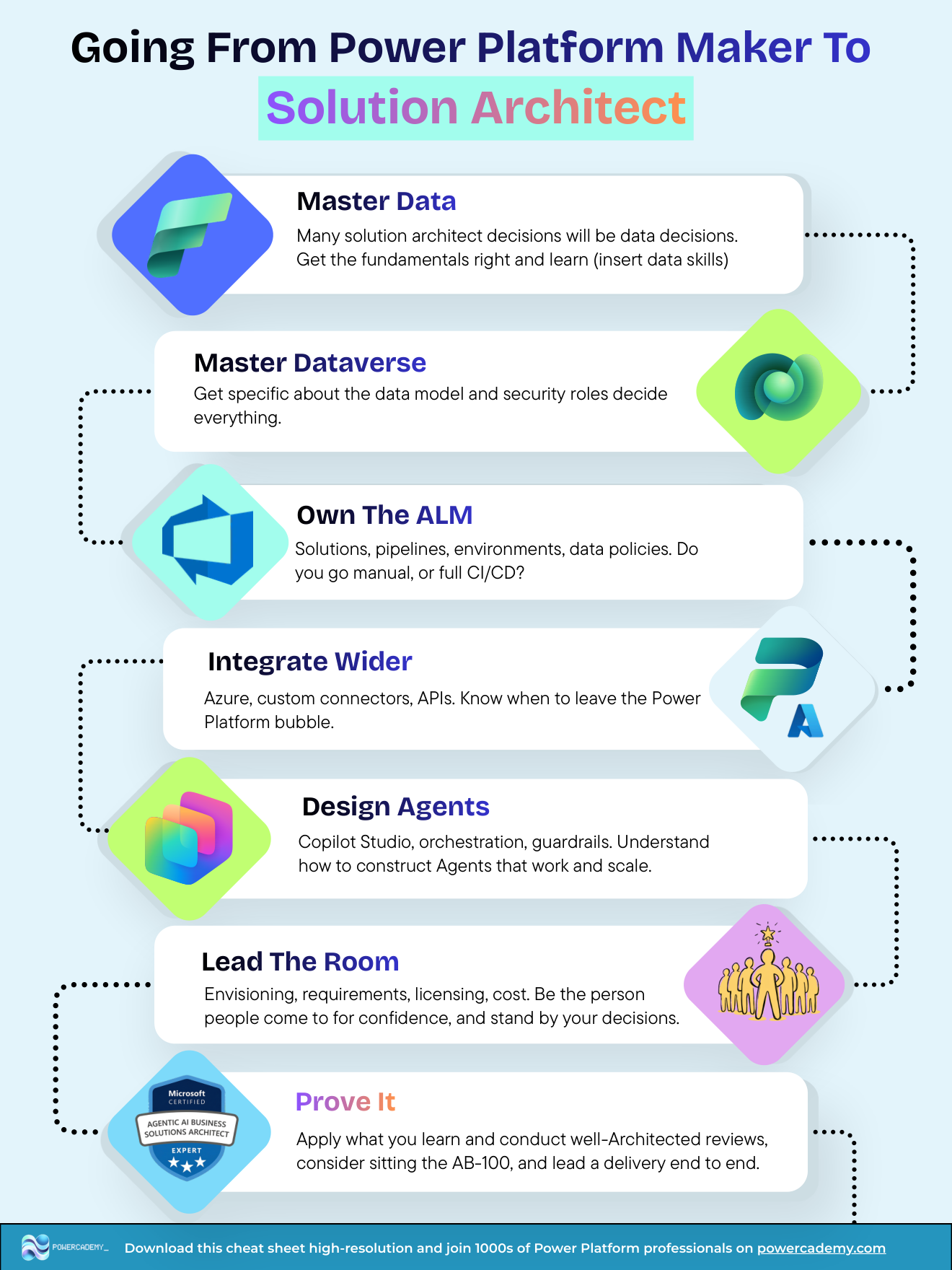
The jump from maker to solution architect is not about building better apps - it is about becoming the person whose decisions other people build on. The route runs through seven stages: mastering data, mastering Dataverse, owning the ALM, integrating beyond the platform, designing agents, leading the room, and proving it end to end. This roadmap covers each stage and why the order matters.
Want the hi-res version? It's free in the Powercademy Success Kit.
What are the seven steps from maker to solution architect?
Master data - Many solution architect decisions are data decisions. Get relational fundamentals, modelling, and integration concepts right first.
Master Dataverse - Get specific: the data model and security roles decide everything else in a Power Platform architecture.
Own the ALM - Solutions, pipelines, environments, data policies. Know when manual is enough and when full CI/CD is warranted.
Integrate wider - Azure, custom connectors, APIs. Know when to leave the Power Platform bubble - and when not to.
Design agents - Copilot Studio, orchestration, guardrails. Understand how to construct agents that work and scale.
Lead the room - Envisioning, requirements, licensing, cost. Be the person people come to for confidence, and stand by your decisions.
Prove it - Conduct Well-Architected reviews, consider sitting the AB-100, and lead a delivery end to end. Judgement only becomes credibility once it has shipped something.
Why do data and Dataverse come first?
Because every downstream decision inherits from them. An architect who models the business correctly can recover from a mediocre app design; nobody recovers from a wrong data model at scale. Dataverse specifics - table types, ownership, security roles, business units - are where abstract data theory becomes enforceable architecture, which is why the roadmap splits them into their own stage rather than folding them into general data skills.
What actually changes at the architect level?
The unit of work changes from solutions to decisions. Makers are judged on what they build; architects are judged on what they choose - tools, boundaries, licences, trade-offs - and on whether they can carry a room while defending those choices. That is why the later stages are about leading and proving rather than new technology: the transition is mental before it is technical. The AB-100 certification (which replaced the PL-600) now frames this as architecting agentic AI business solutions, reflecting where the role is heading.
FAQ
How long does the maker-to-architect journey take?
Typically a few years of deliberate practice rather than months, because the later stages need real projects to exercise judgement on. You can compress it by seeking out data modelling, ALM, and client-facing work early instead of waiting for it to arrive.
Do I need to be a strong coder to be a solution architect?
No - you need to understand what code can do and what it costs. Architects decide when plugins, PCF, or Azure are warranted; they rarely write the majority of that code themselves. Judgement about extensibility beats fluency in it.
What is the AB-100?
Microsoft's Agentic AI Business Solutions Architect certification, which replaced the PL-600 as the architect-level exam. It reflects the role's shift: architecting AI-and-agent solutions across the Microsoft stack, not just Power Platform apps.
Why is agent design on a solution architect roadmap?
Because agents are becoming a standard solution component, and they raise exactly the questions architects own: grounding data, guardrails, ownership, orchestration, and governance. An architect who cannot design an agent safely will be designing around one soon.
The hi-res version is in the Powercademy Success Kit - free, along with hundreds of other cheat sheets, roadmaps, and guides for Microsoft professionals.