The Power Platform Data Architect Roadmap: 9 Skills in Order

Howdang Rashid
Saturday, 22 August 2026 · 3 min read
Data architect is one of the highest-leverage specialisations in the Power Platform world - and one of the least mapped. App makers are everywhere; people who can design the data layer underneath enterprise solutions are rare and paid accordingly. This roadmap lays out the nine skills in the order I'd learn them, from core data fundamentals to securing regulated-industry architectures.
Want the hi-res version with clickable resources? It's free in the Powercademy Success Kit.
What does the roadmap look like?
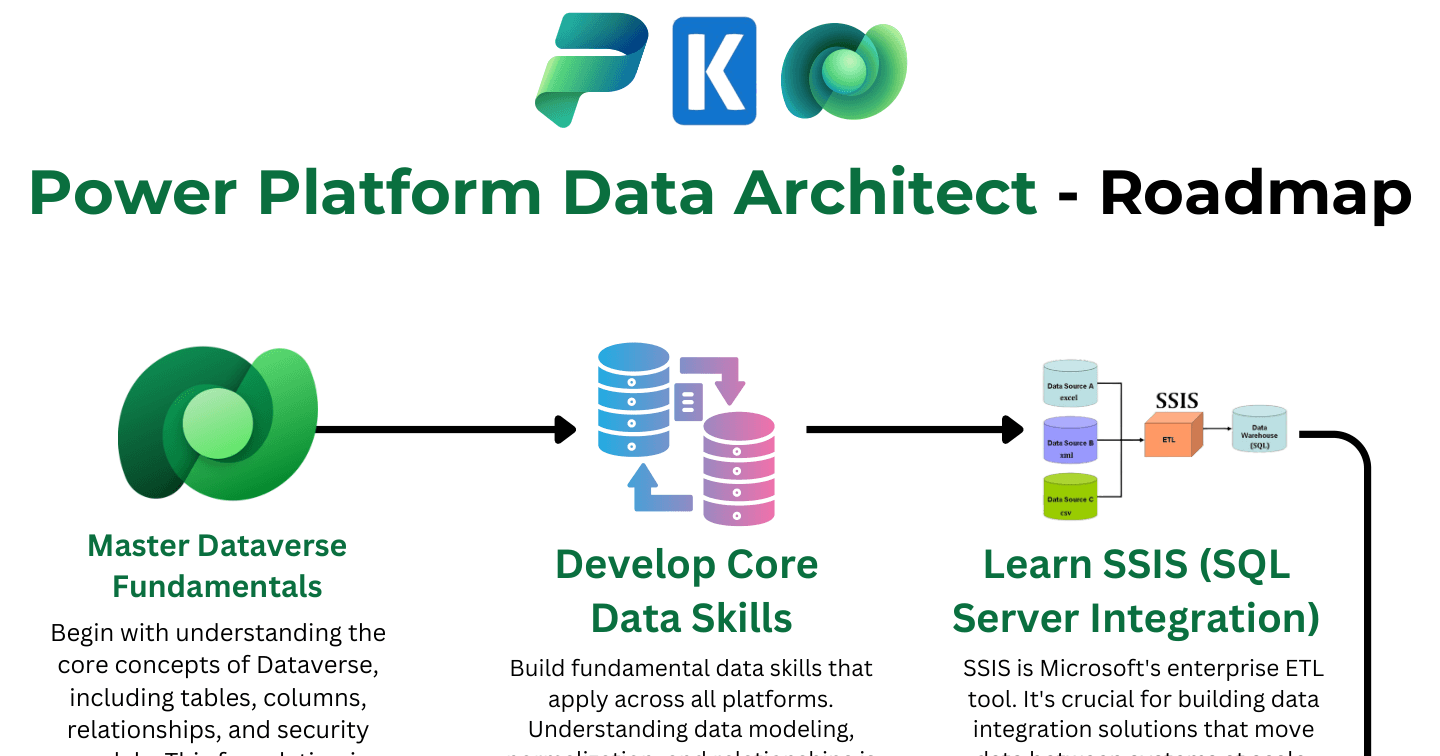
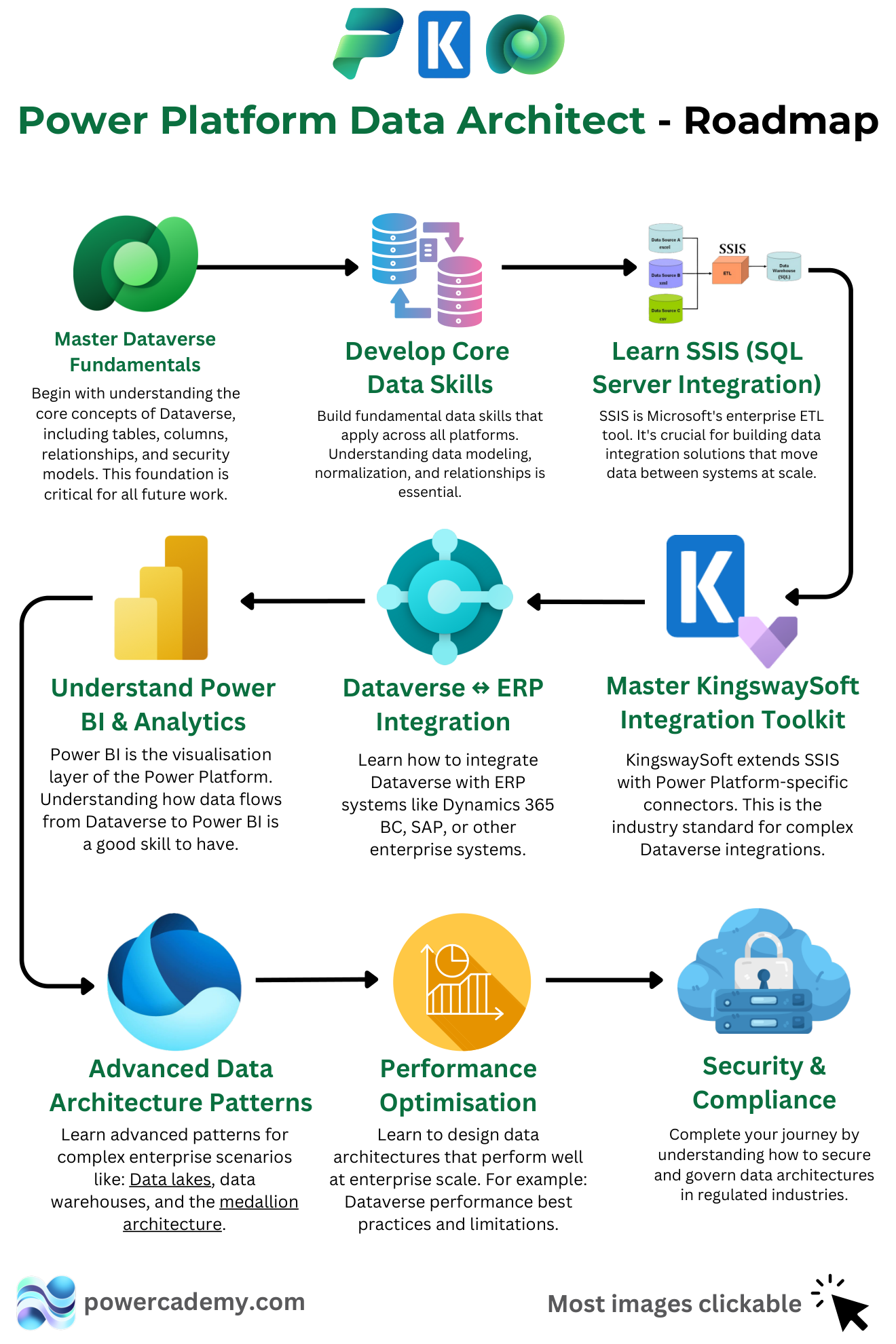
Nine steps, three phases: foundations (core data skills, Dataverse fundamentals, Power BI), integration (SSIS, KingswaySoft, Dataverse-to-ERP), and enterprise architecture (advanced patterns, performance, security and compliance). Each builds directly on the one before it.
Phase 1: Foundations
Develop core data skills. Data modelling, normalisation, and relationships apply across every platform you'll ever touch. Get these right and everything downstream gets easier.
Master Dataverse fundamentals. Tables, columns, relationships, and security models - the foundation every Power Platform data decision rests on.
Understand Power BI and analytics. Power BI is the visualisation layer of the platform; knowing how data flows from Dataverse into reports shapes how you model it in the first place.
Phase 2: Integration
Learn SSIS. SQL Server Integration Services is Microsoft's enterprise ETL workhorse - crucial for moving data between systems at scale, and still everywhere in enterprise environments.
Master the KingswaySoft integration toolkit. KingswaySoft extends SSIS with Power Platform-specific connectors and is the industry standard for complex Dataverse integrations. It's the tool that turns an SSIS developer into a Dataverse integration specialist.
Integrate Dataverse with ERP systems. Dynamics 365 Business Central, SAP, and other enterprise systems - this is where data architecture earns its keep, and where the hardest real-world problems live.
Phase 3: Enterprise architecture
Learn advanced data architecture patterns. Data lakes, data warehouses, and the medallion architecture - the patterns behind complex enterprise scenarios and modern analytics estates.
Optimise for performance. Design architectures that hold up at enterprise scale: Dataverse performance best practices, limits, and when to move workloads elsewhere.
Security and compliance. Finish by learning to secure and govern data architectures in regulated industries - the skill that separates architects who design demos from architects trusted with production.
FAQ
How long does this roadmap take?
With a Power Platform background, expect twelve to eighteen months to genuine data-architect competence - phases 1 and 2 in the first six to nine months, then enterprise patterns learned on real projects. It compounds: each phase makes you more valuable while you learn the next.
Do I really need SSIS in the age of Fabric and cloud ETL?
Yes - the enterprises hiring Power Platform data architects run on SSIS today and migrate slowly. Understanding SSIS also teaches ETL thinking that transfers directly to Fabric pipelines and Azure Data Factory.
What certifications pair with this roadmap?
PL-900 then the Applied Skills for Dataverse-heavy scenarios cover the Power Platform side; add DP-900 (Azure Data Fundamentals) for the broader data estate. Certifications validate the roadmap - the project work is what builds it.
Where does AI fit into a data architect's role?
Everywhere, increasingly. AI features are only as good as the data underneath - grounding, RAG, and agents all depend on well-modelled, well-governed data. A strong data architect is quietly the most important person in any Microsoft AI rollout.
The hi-res version of this roadmap is in the Powercademy Success Kit - free, along with hundreds of other cheat sheets, roadmaps, and guides for Microsoft professionals.