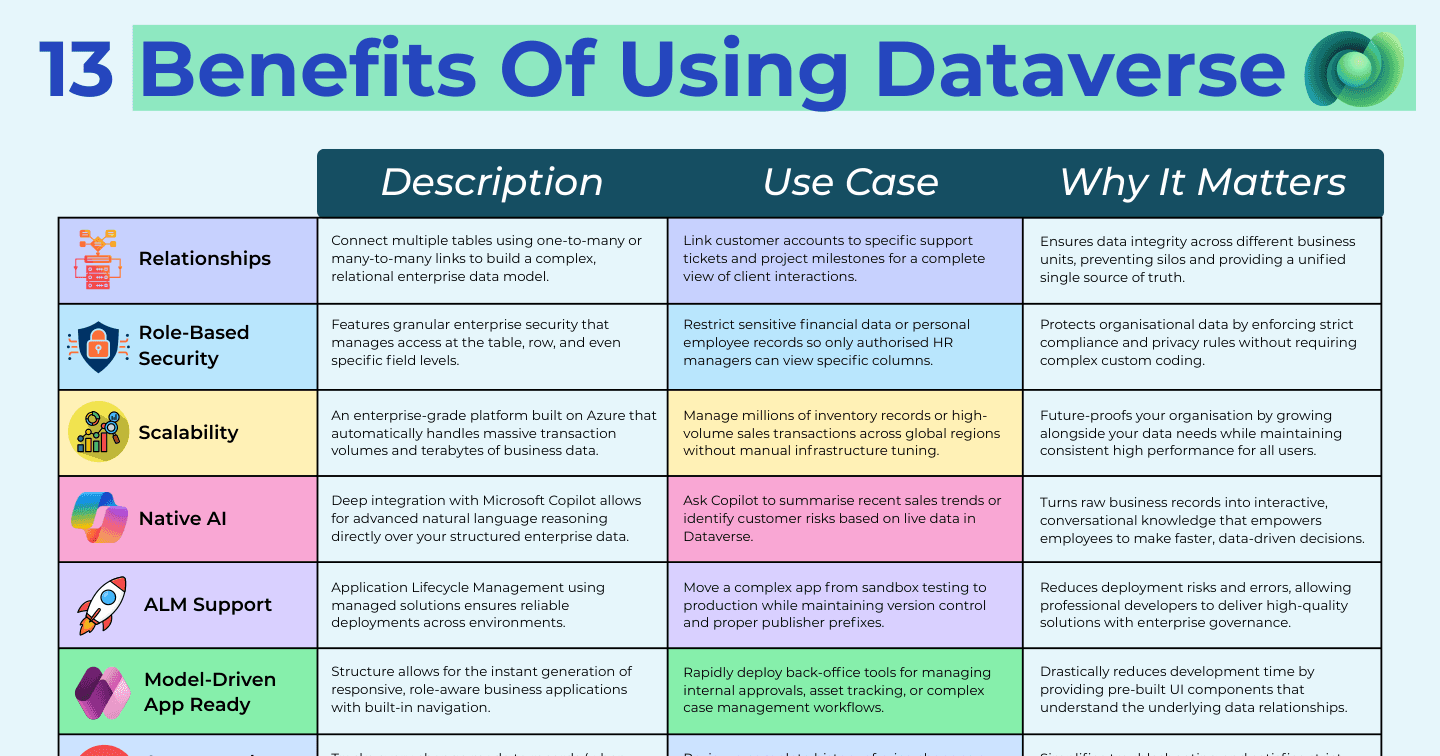
13 Benefits of Using Dataverse (And When Each One Matters)

Howdang Rashid
Saturday, 22 August 2026 · 3 min read
Dataverse costs more than a SharePoint list, and it should - it's doing a completely different job. When someone asks what that premium actually buys, these are the thirteen benefits I point at: a genuinely relational data model, enterprise security, native AI, and the operational maturity (ALM, auditing, integration) that business-critical apps demand.
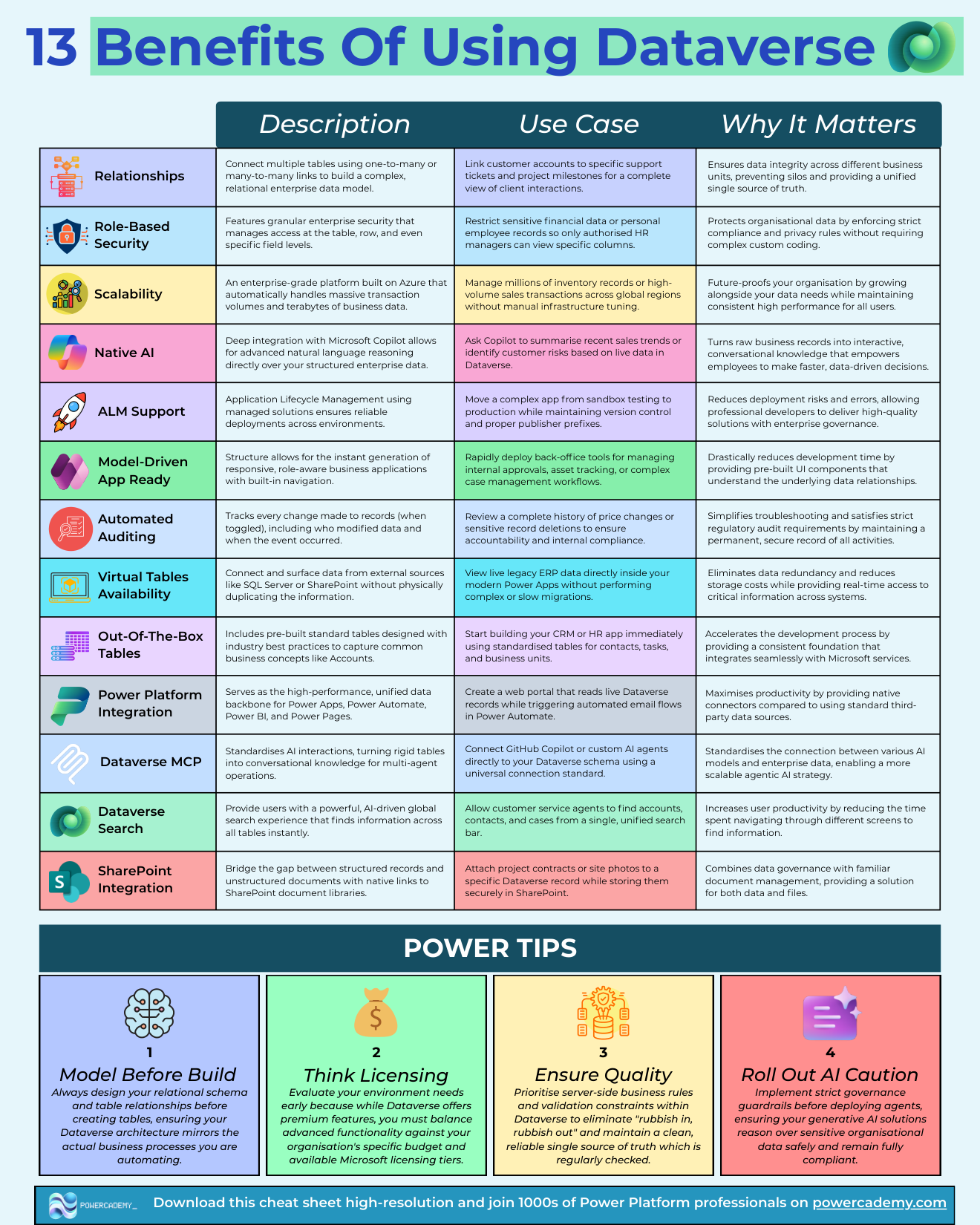
Want the hi-res version with the full description, use case, and why-it-matters for every benefit? It's free in the Powercademy Success Kit.
What are the 13 benefits?
In one list: relationships, role-based security, scalability, native AI, ALM support, model-driven app readiness, automated auditing, virtual tables, availability, out-of-the-box tables, Power Platform integration, Dataverse MCP, and Dataverse Search (with SharePoint integration as the bonus that keeps documents where they belong). The sections below group them into the four arguments that actually win decisions.
Why does the data model matter most?
Relationships let you connect tables with one-to-many and many-to-many links - customer accounts to support tickets to project milestones - preventing silos and giving you a single source of truth. Out-of-the-box tables (accounts, contacts, activities) mean you start from a proven schema instead of a blank page, and virtual tables surface external data inside Dataverse without migrating it.
Model-driven app readiness is the payoff: a well-modelled Dataverse schema generates responsive, role-aware business applications with built-in navigation almost for free - back-office tools for approvals, asset tracking, and case management in days rather than months.
How strong is the security and governance story?
Role-based security manages access at table, row, and even column level - restrict sensitive financial data or personal records so only authorised roles see specific fields, with no custom code. Automated auditing tracks who changed what and when, and ALM support via managed solutions gives you reliable Dev-to-Test-to-Production deployments with version control - the difference between governed delivery and the wild west.
What does Dataverse give AI that other stores don't?
Native AI means deep Copilot integration reasons over your structured data directly - ask for sales trends or customer risks in natural language and get answers grounded in live records. Dataverse MCP extends that to the agent era, giving AI agents a standard way to reach your business data, and Dataverse Search delivers fast, relevance-ranked search across everything. Clean schemas and relationships are exactly what AI needs - and exactly what Dataverse enforces.
Does it hold up operationally?
Scalability comes from the Azure foundation - millions of records and high transaction volumes without manual infrastructure tuning. Availability is enterprise-grade and managed for you, and Power Platform integration puts your data at the centre of apps, flows, and analytics with consistent security. SharePoint integration completes the picture: documents live in SharePoint libraries, structured data lives in Dataverse, and users see one experience.
FAQ
Do I need premium licences for Dataverse?
Yes - Dataverse requires premium Power Apps licensing (per-user or per-app). That's the honest cost of the thirteen benefits above, and why the decision deserves a proper comparison rather than a default.
Is Dataverse overkill for a small team app?
Sometimes. If the data is flat, low-volume, low-sensitivity, and short-lived, SharePoint or Excel may genuinely be fine. Dataverse earns its cost when relationships, security, scale, or auditability enter the requirements.
What is Dataverse MCP?
Model Context Protocol support for Dataverse - a standard interface that lets AI agents query and act on your business data with governed access. It's what makes Dataverse-backed data agent-ready rather than just app-ready.
Can Dataverse and SharePoint work together instead of competing?
Yes - and mature teams usually land there: structured, relational data in Dataverse; documents in SharePoint libraries linked to Dataverse records. Each system does what it's best at.
The hi-res version of this cheat sheet is in the Powercademy Success Kit - free, along with hundreds of other cheat sheets, roadmaps, and guides for Microsoft professionals.